+201007892200WhatsAppع

Insect and rodent control services

All services

Not sure what the pest is? Send a photo or a short description on WhatsApp and we will tell you what it is and how to treat it.

Elalmanya BiologyHomes and businessesSame day, any governorate

Flea treatment: your home and your pet, treated at the same time

Adult fleas live on your cat or dog, but their eggs fall off onto the carpet, the sofa and the pet's bed, and that's where the next generation grows. So we treat your home in the same week the vet treats your pet, not after.

  • Carpets and upholstery
  • Pet sleeping areas
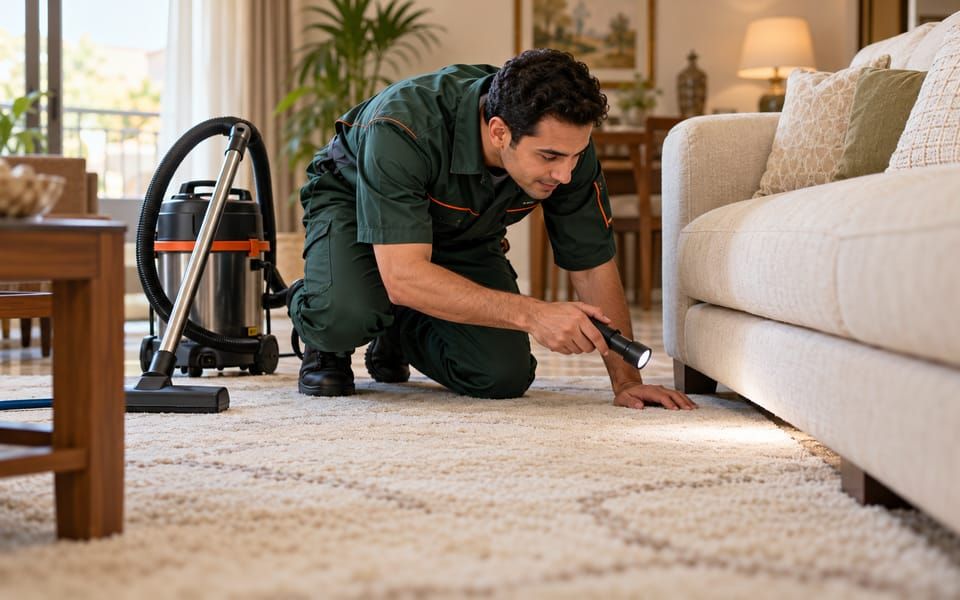
Illustrative photo of a technician without a mask inspecting a rug next to a sofa

In short

Flea treatment works when the home and the pet are treated together. The vet treats your cat or dog. We treat the carpets, sofas and sleeping spots where eggs and larvae live, and you vacuum daily or every other day. Expect a few new fleas for about two weeks, as they come out of cocoons the product can't reach.

  • Flea control specialists
  • Carpet, sofa and upholstery treatment
  • A plan built around the flea life cycle
  • We find the source before treating
  • Cost explained before the visit
  • Safety instructions first
  • Follow-up when your case needs it
  • Homes, offices and restaurants

Signs

Signs of fleas in your home

The two clearest signs are bites low on the body, around the ankles and legs, and a cat or dog scratching more than usual. For a quick test, pull on white knee-high socks and walk near your pet's bed. Any fleas will jump onto the socks and show up as dark specks. Take a photo and send it to us.

  1. Bites on the ankles and legs

    Small, itchy red bumps, mostly on the ankles and below the knee, because fleas jump up from the carpet or floor. You notice them after sitting on the sofa your cat sleeps on, or after walking barefoot in the room where its bed is.

  2. Your pet scratches and loses hair

    Your cat or dog scratches and chews at its fur a lot, and sometimes hair falls out in patches and the skin turns red. Some animals are allergic to flea bites, and one bite is enough to set off heavy itching. That's a case for the vet.

  3. Black specks with a reddish tint

    Part your pet's fur or shake out its bed. If you find a fine black powder with a reddish tint, that's adult flea droppings, which are dried blood. It means fleas are feeding, and that larvae have food in the same spot.

  4. The flea itself

    A wingless insect 1 to 3 mm long, reddish brown to black, with a body flattened from side to side so it slips easily through hair. You usually spot one when it suddenly jumps off the carpet, or out of your pet's fur while you comb it.

  5. Bites after moving in or coming back from a trip

    You moved into an apartment that once had a cat or dog, or came home after a long time away, and in the first few days your legs are covered in bites. Those are fleas that were waiting inside their cocoons and came out hungry as soon as they sensed people moving around.

  6. Found one of these signs? Take a photo and send it to us, and we will tell you whether it is fleas or something else before any visit.

    Send the photo

Where do fleas in the house come from?

A female flea needs a blood meal from an animal before she starts laying eggs, so it usually begins with a cat or a dog. It doesn’t have to be your pet, though. Street cats that sleep in the air shaft, under the stairs or in the garden leave eggs and cocoons in those spots, and an adult flea can hitch a ride on your shoe or the leg of your pants and come into the apartment with you.

If no animals live in your home at all, look for one that visits. It could be a cat giving birth in the storage loft or on the roof of the building, or cats feeding from the trash next to your front door. Treating the home while that source is still open means the fleas will come back the same way.

The flea life cycle: why do fleas come back after treatment?

A flea goes through 4 stages, and each stage lives in a different part of your home:

  • Eggs are laid in the pet’s fur and drop onto the floor and furnishings. They hatch in about 2 to 5 days.
  • Larvae live between carpet fibers and under furniture for 8 to 15 days, feeding on the droppings of adult fleas.
  • Cocoons are where the flea finishes developing. It stays inside for 1 to 4 weeks, and longer if the home is empty or the weather is cold.
  • Adult fleas look for an animal or a person to feed on as soon as they come out, and once they find an animal, they stay on it.

The whole cycle can take about 18 days at normal indoor temperatures, or stretch to 75 days depending on heat and humidity. So the fleas jumping in front of you today are the last link in the chain. Under them, in the carpet, a whole generation hasn’t come out yet.

What confuses people is that insecticide doesn’t reach the cocoon. A few days after the treatment you see new fleas and think it failed. In fact, they are fleas coming out of their cocoons onto a treated floor, and they keep coming out like this for about two weeks. Vacuuming every day makes them come out faster, so that period gets shorter.

Fleas in an empty apartment: why do they bite as soon as you move in?

This story comes up again and again. People move into a new apartment, or come back from a summer holiday, and within a day or two their legs are full of bites. The cause is fleas waiting in their cocoons. When an apartment stays closed with no animals and no people, the fully formed flea stays inside its cocoon, sometimes for months. As soon as someone walks across the floor, the vibration, the warmth and human breath wake it up, and it comes out hungry and jumps onto the nearest leg.

The same thing happens when the cat leaves the house. The fleas that come out of cocoons after that have nobody to bite except the people living there, so bites can increase after the pet is gone instead of dropping.

If you rent out an apartment, it’s much easier to treat it after a tenant with a pet moves out, and before the new tenant moves in, than to deal with a complaint a week later. A good vacuum of the carpets before the treatment removes some of the eggs and brings fleas out of their cocoons while the product can still reach them.

When should you call a flea control company?

If the vet has treated your pet, you’ve been vacuuming daily or every other day, and two weeks later the bites haven’t stopped, some spots in the home haven’t been treated. The same goes for fleas in more than one room, in large carpets and fabric sofas that are hard to wash, or bites from day one in a new apartment. If you still see adult fleas 4 weeks after treatment, the place needs another look.

Send us a photo of the bites or of a flea on WhatsApp at +201007892200, and tell us the number of rooms, the type of flooring and where your pet sleeps. We can be with you the same day in any of Egypt’s 27 governorates, and before the treatment the technician tells you when to take the pets out and when you can all come back. Other ways to reach us are on the contact page.

Why it comes back

Why doesn't treating the cat alone get rid of fleas?

The fleas on your cat are a small part of the problem. Their eggs fall onto carpets and sofas, larvae grow under furniture away from sunlight, and cocoons shield what's inside from insecticide. If the pet is treated and the home isn't, the new generation comes up from the floor and climbs back on, or bites whoever lives there.

50eggs a day from one flea

The eggs can drop off the animal onto carpets and soft furnishings. That is why treating your pet alone does not deal with the fleas already in your home.

Source: Univ. of Kentucky
  1. The eggs don't stick to the fur

    A female flea lays her eggs in your pet's fur, but the eggs are white, tiny, smooth and dry, so they drop wherever the animal sits or sleeps, like the carpet, under the sofa cushions or its bed on the balcony. Your home turns into an egg store.

  2. The larvae hide in the carpet

    A flea larva is a tiny worm, 1.5 to 5 mm long. It lives between carpet fibers, under sofas and inside the pet's bed, and feeds on the droppings of adult fleas. It needs high humidity and can't survive in sunlight, so it settles in closed spots that light never reaches.

  3. Insecticide can't get into the cocoon

    The larva wraps itself in a sticky cocoon, and dust and hair cling to it so you can't see it. Insecticide doesn't get inside. In cold weather the flea can wait in there for months, then come out when it senses vibration, warmth or the breath of someone close by.

Treatment

How we get rid of fleas in your home, step by step

The job takes 5 steps, and your pet and your home are treated on the same days. You book the vet for your cat or dog. We help you prepare the home and treat the places where eggs and larvae live. Then it's the vacuum's turn, so fleas leave their cocoons while the product is still on the floor.

  1. Questions before the visit

    We ask whether you have a cat or dog, where it sleeps, when the bites started and in which rooms. If there are no pets at home, we ask about street cats in the air shaft, on the balcony or under the stairs, since they may be the source. A photo of the bites or of a flea saves a lot of time.

  2. Your pet's treatment at the vet

    Treating the cat or dog is the vet's job, and the vet picks the right product for the animal. Try to book the vet on the same day as the home treatment, or close to it, so your pet doesn't go back to sleeping on a carpet still full of eggs and larvae.

  3. Preparing the home

    Pick up toys, clothes and anything else on the floor, and wash the pet's bed and small rugs in hot, soapy water. Then vacuum the carpets and sofas well, under the furniture and along the walls. Vacuuming lifts the carpet pile, so the product can get underneath.

  4. Treating where eggs and larvae live

    The technician treats carpets, sofas, the floor under furniture and along the walls, with a focus on where your pet sits and sleeps. The product suits the case and goes onto floors and upholstery, not into the air of the room. If street cats use the balcony or air shaft, we check those spots too.

  5. Vacuuming after the treatment

    Vacuum every day or every other day for about two weeks. It removes eggs and larvae, and it makes fleas leave their cocoons early so they land on the treated surface. Seal the vacuum bag inside a garbage bag and take it out of the house. If you still see fleas after 4 weeks, call us and we'll check again.

Ready for the first step? Tell us what you saw.

Safety

Is flea spraying safe for cats and children?

Safety depends on the product, how it's applied and who lives in the home. Before the visit we ask about cats, dogs, birds and fish tanks, and about children, pregnancy and allergies, then tell you how long to stay out and when to come back. Nothing used on the home goes on the pet itself; the vet handles its treatment.

  • Cats, dogs and birds

    Take them out of the rooms being treated, and don't bring them back until the carpets and floors are completely dry. Cover the fish tank, switch off the pump and move the birdcage away. Never put a household insecticide on your pet. It needs a product chosen by the vet.

  • Children and pregnancy

    Tell us on the first call. Small children crawl and play on the carpet and put their hands in their mouths, so when they can go back into the room depends on the product. Keep them off the treated floor until it's fully dry.

  • You have a right to know the product

    Ask the technician for the product's name and details before they start. If anyone at home has asthma or a skin allergy, tell us before the visit so we can choose an application method that suits them.

  • If someone feels unwell after the treatment

    If a child swallows something from a treated area or someone feels unwell, call an ambulance on 123 or go to the nearest hospital, and take the product's name with you. If your pet shows any sign of illness, call the vet right away.

Who it is for

Flea control for homes, vet clinics and rental apartments

Fleas turn up wherever there are animals, or were until recently, such as an apartment with a cat, a rental that's still empty, a vet clinic, a pet shop or a warehouse where street cats sleep. The cases differ in where the fleas come from and how much space needs work, and commercial sites need regular follow-up.

Homes and apartments

At home, we time the treatment around the vet appointment and focus on the rooms where your pet spends its time. Send us the number of rooms, whether the floors are carpet or tile, and where the cat sleeps, and we'll tell you how to prepare. If there are no pets, we start with the air shaft, balcony and roof.

Send details of your home

Businesses and offices

Vet clinics and pet shops take in new animals every day, so fleas can come back after a one-time treatment. The plan covers waiting areas, cages and storerooms, with a follow-up schedule. In warehouses and factories, we start by finding where street cats sleep and show you how to block their way in.

Ask for a business quote

Price

What sets the price of flea treatment?

No single price fits every case. An apartment with one infested room is not the same as a whole apartment, and a home is not the same as a business. The cost depends on these four factors, and we explain it in detail before you confirm the booking, with no surprise charges after the visit.

  1. Size and type of placeA 90-square-meter apartment is not the same job as a villa with a garden, and a restaurant is not the same as a warehouse.
  2. Type of pestEach pest needs its own product and method. Gel bait for cockroaches, bait stations for rats and mice, and wood injection for woodworm.
  3. How far it has spreadA first sighting a week ago is different from an infestation that has been there for months. That is why we ask for photos and signs.
  4. How many visits the case needsSome cases need a follow-up or an extra visit. We decide that after checking which insects or rodents are involved and how far they have spread.

Ask for the quote to show:

  • Inspection and finding the source
  • The products used and their details
  • Number of visits and the follow-up needed
  • Terms and length of any guarantee, if there is one
  • How we record what was done on the visit

Coverage

Flea treatment in every governorate, same day

We cover all 27 governorates of Egypt with same-day visits. Send your area and the problem on WhatsApp or call us, and we will set a visit time for your home or business. The groups below show the main cities and districts in each region we reach.

  • Greater CairoCairo, Giza and Qalyubia, including Nasr City, New Cairo (Fifth Settlement), Rehab City, El Shorouk, Madinaty, Maadi, Heliopolis, Helwan, 6th of October, Sheikh Zayed and Mohandessin
  • Alexandria and the CoastAlexandria, Beheira, Matrouh and the North Coast
  • The DeltaGharbia, Monufia, Dakahlia, Sharqia, Kafr El Sheikh and Damietta
  • Canal Cities and SinaiPort Said, Ismailia, Suez, North Sinai and South Sinai
  • Upper EgyptFaiyum, Beni Suef, Minya, Asyut, Sohag, Qena, Luxor and Aswan
  • Red Sea and New ValleyRed Sea and New Valley
Send your area and book today

Questions

Common questions about fleas

These are the questions people in Egypt ask most about fleas, with answers from our daily work. If yours is not here, type it in the box below. It lands in our WhatsApp, and one of the team replies about your exact situation.

Are flea bites dangerous?

In most cases, no. The bites leave itchy red bumps on the ankles and legs. In rare cases fleas can pass diseases to people, and a pet can pick up tapeworm if it swallows a flea while licking its fur. If a bite swells or gets inflamed, or you run a fever, see a doctor.

What's the difference between fleas and bed bugs?

Fleas jump. They live on the cat or dog, their eggs end up in carpets and the pet's bed, and they usually bite your ankles and legs. Bed bugs hide in mattress seams and cracks in the bed frame, and you find their bites in the morning on your arms and neck. Not sure which you have? Send us a photo of the insect on WhatsApp and we'll tell you.

What's the fastest way to get rid of fleas?

Treat the pet and the home in the same week. That means the vet for the animal, treatment for the carpets, sofas and its sleeping spots, and vacuuming daily or every other day. Even then you'll see fleas for about two weeks, because they leave their cocoons a few at a time and land on the product on the floor.

Which flea killer works best?

No single product is enough, because what kills adult fleas doesn't reach the cocoon. University of Kentucky guidance recommends a product for adult fleas plus one that stops eggs and larvae from developing, applied to the floors and furnishings. Your pet needs a different product chosen by the vet, so never put a household insecticide on it.

Do fleas live in your bed?

Adult fleas stay on the animal, not in the bed. But if your cat sleeps on your bed, its eggs fall onto the sheets and comforter, and larvae can grow in and around the mattress. Wash the sheets and your pet's bedding in hot, soapy water at least once a week, and vacuum the mattress and the floor under the bed.

Why did fleas show up after the cat left?

Because the fleas in cocoons don't leave with the cat. A flea stays in its cocoon until it senses movement or warmth, then comes out hungry, and when it can't find the animal it bites the people in the house. That's why the carpets and the cat's old sleeping spots need treatment, even after the pet is gone.

What season do fleas appear in?

Their numbers clearly rise in spring and early summer as the weather warms up. Winter doesn't mean they're gone, though. A fully formed flea can stay in its cocoon for up to 12 months in cold weather and come out as soon as it warms up or someone walks by. So treat your home as soon as you notice bites.

Not sure where to start? Tell us the problem and we'll plan the next step with you.

+201007892200
Browsing on a computer?
Scan the code and call us from your phone.